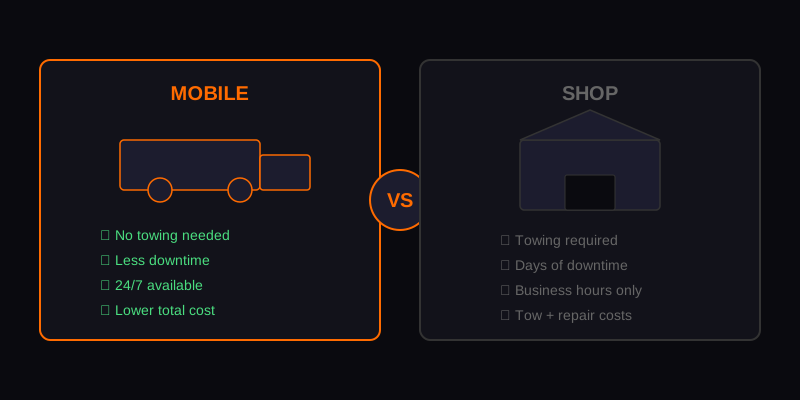
Mobile Truck Repair vs. Shop Repair: Which One Actually Saves You Money?
I run a mobile truck repair business, so you might expect me to tell you that mobile is always better. But I’m not going to do that, because it’s not always true. I’m Albert, owner of Albert’s Road Service in West Palm Beach, and I believe in being straight with people. Some repairs belong in a shop. But a lot more repairs can — and should — be done mobile than most people realize.
Let me break down the real differences, the real costs, and help you make the right call for your situation.
The Real Cost Comparison
Let’s start with what everyone wants to know: money. I’m going to use a common repair — replacing a pair of batteries and an alternator — to show the true cost difference.
Scenario: Dead Batteries + Failed Alternator on I-95 Near West Palm Beach
Option A: Tow to a Shop
| Item | Cost |
|---|---|
| Heavy-duty tow (I-95 to nearest shop) | $1,500 - $2,500 |
| Shop diagnostic fee | $150 - $250 |
| Parts (2 batteries + alternator) | $600 - $900 |
| Shop labor (2.5 hours × $175/hr) | $437 |
| Wait time (1-2 days for bay availability) | $0 on paper |
| Driver hotel + meals (1-2 nights) | $200 - $400 |
| Lost revenue (1-2 days off the road) | $600 - $2,000 |
| Total real cost | $3,487 - $6,487 |
Option B: Mobile Repair On-Site
| Item | Cost |
|---|---|
| Service call fee | $150 - $250 |
| Parts (2 batteries + alternator) | $600 - $900 |
| Mobile labor (2 hours × $150/hr) | $300 |
| Downtime (2-3 hours total) | Minimal |
| Total real cost | $1,050 - $1,450 |
The difference is stark: $2,400 to $5,000 in savings on a repair that takes a competent mobile mechanic about 2 hours. And you’re back on the road the same day.
Now multiply that by the number of times a truck or fleet has a breakdown in a year. The average Class 8 truck has 2-3 unscheduled repair events per year. If even one of those is a mobile-fixable issue, you’ve already paid for a full year of preventive maintenance.
When Mobile Repair Wins (Most of the Time)
Here’s what I fix on the road every single day:
Electrical System
- Battery replacement (the most common call I get in Florida)
- Alternator replacement
- Starter replacement
- ABS sensor replacement
- Wiring repairs and connector cleaning
- Lighting repairs (DOT compliance)
Brake System
- Brake chamber replacement
- Slack adjuster replacement
- Brake shoe/pad replacement
- Air line repair
- S-cam and bushing replacement
- Full brake jobs on drive and trailer axles
Cooling System
- Thermostat replacement
- Water pump replacement
- Radiator hose replacement
- Coolant flush and fill
- Fan belt replacement
- Heater hose repair
Aftertreatment / Emissions
- DEF sensor replacement
- DEF dosing unit replacement
- NOx sensor replacement
- DPF forced regeneration
- DEF pump replacement
- EGR valve service
Air System
- Air compressor replacement
- Air dryer cartridge replacement
- Air line repair and fitting replacement
- Leveling valve replacement
- Air bag (suspension) replacement
Fuel System
- Fuel filter replacement
- Fuel water separator service
- Fuel line repair
- Fuel pump diagnosis
Tires
- Tire changes (drive and trailer)
- Emergency flat repair
- Tire pressure monitoring
General
- Turbo actuator replacement
- Serpentine belt replacement
- Glad hand replacement
- Fifth wheel service
- Light bulb and electrical connection repair
- DOT inspection prep
That covers probably 75-80% of all unscheduled truck repairs. The vast majority of the time, a well-equipped mobile mechanic can handle the job.
When You Need a Shop
I’ll be the first to tell you when a repair needs a shop. Here’s what I send to shops:
Major Engine Work
- Injector replacement (some engines — depends on access)
- Head gasket replacement
- In-frame overhaul
- Crankshaft/bearing work
- Cylinder liner replacement
Transmission
- Clutch replacement on automated manual transmissions
- Internal transmission repair
- Transmission replacement (needs a crane/hoist)
Differential/Drive Axle
- Ring and pinion replacement
- Carrier bearing replacement
- Major axle shaft work
Frame and Structural
- Frame rail repair or replacement
- Spring hanger welding
- Major suspension component replacement requiring alignment
Specialty Work
- DPF bake-out cleaning (requires specialized equipment)
- Dyno testing
- A/C evacuation and recharge (EPA regulations)
- Major body/cab repair
- Alignment (requires alignment rack)
Why These Need a Shop
These repairs require lifts, cranes, specialized tools, or controlled environments that you can’t replicate on the shoulder of I-95 or in a truck stop parking lot. There’s no shame in a shop repair when it’s the right call.
The Hidden Costs Nobody Talks About
Shop Hidden Costs
Wait time. This is the killer. When I worked in shops before starting my mobile business, I saw trucks sit in the parking lot for 1-3 days before they even got into a bay. The shop wasn’t trying to screw anyone — they were just busy. But that truck sitting in the lot is burning money.
In South Florida, the good diesel shops are always backed up. There aren’t enough qualified diesel technicians to go around, and every shop within 50 miles of I-95 has a waiting list. When your truck is in that line, you’re paying for:
- Driver wages (they’re on the clock even when the truck isn’t moving)
- Hotel and per diem ($150-$300/night in the Palm Beach area)
- Lost load revenue ($500-$1,000/day for a typical OTR operation)
- Potential detention charges from your customer
- Late delivery penalties
- Rescheduling costs
Diagnostic markup. Many shops charge a diagnostic fee ($150-$350) that may or may not be applied to the repair. And some shops pad the diagnostic time because they make money whether the truck is being worked on or sitting there.
Parts markup. Shops typically mark up parts 30-50% over their cost. A $200 alternator becomes a $300 alternator on your invoice. This is standard industry practice, but it adds up.
“While we’re in there” upselling. “We noticed your [unrelated part] is also worn — we recommend replacing it while we have it apart.” Sometimes this is legitimate. Sometimes it’s not. If you don’t have a trusted shop, you’re at their mercy.
Mobile Hidden Costs (Being Honest)
Service call fee. Most mobile mechanics charge a trip fee ($100-$300) on top of the repair. This covers our fuel, insurance, and time driving to you. It’s usually less than a tow, but it’s a real cost.
Parts availability. I carry a lot of common parts on my truck, but if I need something specialized, there might be a delay while I source it. In West Palm Beach, I have good relationships with parts houses that can get me most things same-day, but obscure parts might take a day.
Weather limitations. In Florida, afternoon thunderstorms from May through October can shut down outdoor work for an hour or two. I work through light rain, but standing in a puddle working on a 12-volt electrical system during a lightning storm is a hard no.
Lighting. Night repairs are possible (I have a fully lit service truck), but some complex diagnostics are easier in daylight. I’ll still come out at 3 AM for an emergency, but if it can wait until morning, the repair might go smoother.
The Speed Factor
This is where mobile repair absolutely dominates.
Average time from call to rolling (mobile): 2-4 hours for most repairs in my service area. I answer the phone, diagnose over the phone, load the right parts, drive to you, fix it, and you’re gone.
Average time from arrival to rolling (shop): 1-5 days. That includes the tow, the wait for a bay, the diagnostic, parts ordering if they don’t have it, the actual repair, and the pickup. Even a simple repair can take 2 days if the shop is busy.
For an owner-operator or small fleet, those extra days aren’t just an inconvenience — they’re an existential threat. A truck that doesn’t move doesn’t make money, and the bills don’t stop.
Fleet Management: The Smart Approach
If you manage a fleet in the South Florida area, here’s what I recommend:
Use Mobile for:
- All emergency roadside repairs
- Routine PM services (I come to your yard on a schedule)
- Pre-trip / DOT inspection prep
- Minor repairs caught during PMs
- Battery replacements (quarterly in Florida)
- Brake inspections and adjustments
Use a Shop for:
- Major engine work
- Transmission and drivetrain overhauls
- Frame and structural repairs
- Annual inspections that require a lift
- Work requiring specialized equipment
The Hybrid Approach
The smartest fleet managers I work with use a combination. I handle their PMs and emergency calls — which covers 80% of their maintenance needs — and they have a shop relationship for the big stuff. This way, they’re not paying shop overhead and wait times for routine work, but they have shop access when they need it.
Questions to Ask Any Mobile Mechanic
Not all mobile mechanics are created equal. Before you call someone, ask:
- Are you insured? Liability and garage keeper’s insurance are essential. If a mobile mechanic damages your truck, you need protection.
- What do you carry on your truck? A well-stocked service truck has batteries, starters, alternators, brake parts, air fittings, hoses, belts, common sensors, and diagnostic tools. If they’re showing up in a pickup truck with a toolbox, think twice.
- Do you have diagnostic software? Modern trucks require OEM-level diagnostic tools. I use industry-standard diagnostic software that covers Freightliner, Kenworth, Peterbilt, Volvo, International, and more. Without proper diagnostics, a mobile mechanic is guessing.
- What’s your response time? In the Palm Beach County area, I’m typically on-site within 60-90 minutes. If someone quotes you 4+ hours, keep calling.
- Do you guarantee your work? I stand behind every repair. If something I fixed fails within a reasonable time, I’ll make it right.
The Bottom Line
Mobile truck repair isn’t just a convenience — it’s a fundamentally better economic model for the majority of truck repairs. You eliminate the tow, you eliminate the wait, you eliminate the driver downtime, and you get back on the road faster.
But it’s not the right choice 100% of the time. The key is knowing which repairs belong roadside and which belong in a bay. And that’s what I do — I give you an honest answer on the phone before I even start my service truck.
Albert’s Road Service — 561-475-8052 — 24/7 mobile truck and trailer repair in West Palm Beach, Palm Beach County, and South Florida.
Call me. I’ll tell you the truth about what your truck needs and the best way to fix it.
Albert is the owner of Albert’s Road Service LLC — a 24/7 mobile truck and trailer repair service based in West Palm Beach, Florida. For honest mobile truck repair or a straight answer about what your truck needs, call 561-475-8052.